
Rebel Banker Futurist
100 FTEP (Full Time Equivalent Person) work output
BROK in every pocket — for individuals, freelancers, creators, traders, and all economic entities.
Rebel Banker Futurist
BROK in every pocket — for individuals, freelancers, creators, traders, and all economic entities.
Ingram Mercantile
Trade Elevated
Digital asset checkout for the shop you already have.
Custom cash out options available for qualified merchants.
Capabilities · FTEP
BROK is an always-on proxy for how you work, decide, and build wealth: financial literacy for the singularity economy, foresight at whatever level you’re at, and structured decision-making with patented IEM (Ingram Evaluation Matrix) insights — from banking to healthcare to warfare and everything between.
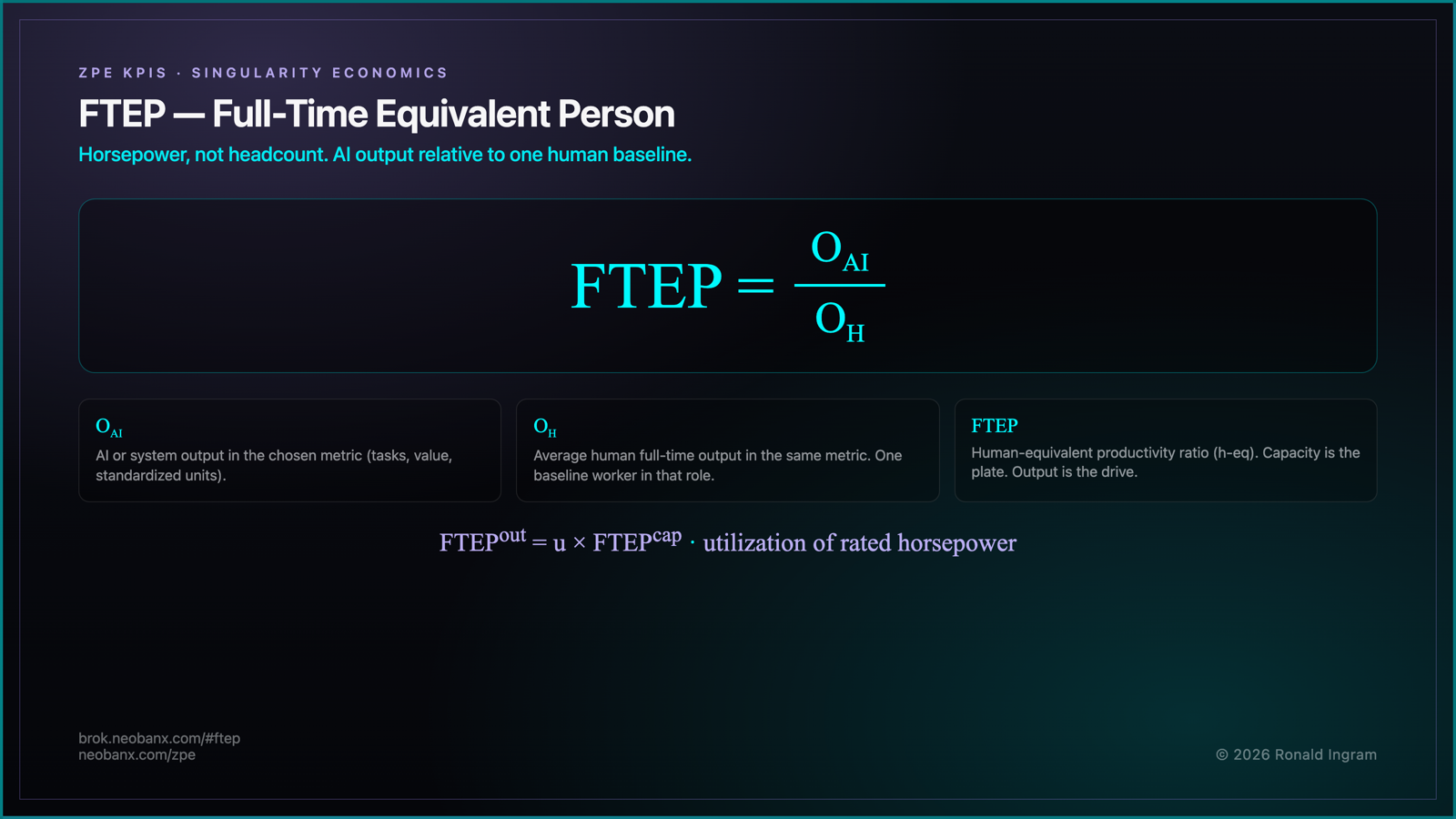
In the singularity economy, the unit that matters is not headcount — it is productive capacity. FTEP is rated like engine horsepower: maximum human-equivalent output when the machine is fully fueled, not the watts you happen to be using this hour.
BEAM (BROK Engagement Activation Machine) is the engine. Named seats (Hestia, Mars, Melissa, …) are cylinders. Capacity is the sum of those seats at full fuel. Actual output is lower because the Founder, Kiron (orchestration), and Governess (guardrails) govern the engine on purpose — the same way a governor caps RPM. Nations will score FTEP capacity first, then utilization.
~100 FTEP capacity
Rated horsepower — not this hour’s usage
One FTEP is one average human in that role. BEAM’s rated capacity is the sum of named seats at full fuel — on the order of ~100 human-equivalents for Neobanx/BROK today. That is the size of the engine, not a claim that 100 people are currently running unsupervised. Governed output (Founder × Kiron × Governess) is the power you are allowed to use. See Singularity Economics for the formulas.
ZPE
Zero Person Enterprise — team-scale output, sovereign control
Imagine the impact on GDP if unemployed, disabled, and disenfranchised humans can each create ZPEs — team-scale enterprises without a traditional org chart. Scaled to families and nations, that is a step change in national productivity, revenue, and abundance: more people generating real economic output under sovereign control, not locked out of the legacy payroll model.
Time + healthspan
The assets FTEP and abundance are meant to protect
With abundance and economic stability come higher aspirations — and wealth without health is hollow. From the start of the wealth-and-abundance journey, BROK provides health education and access to non-medical health research: tools and knowledge for seekers on the quest for health alongside financial freedom. Not medical advice — education and research framing so you can pursue longevity with the same intentionality as capital.
FTEP
https://brok.neobanx.com/#ftep
ZPE Index (listing, proposals, attribution): https://neobanx.com/zpe
© 2026 Ronald Ingram
A new economic theory for a new age — the age of the singularity in AI — encompassing crypto, robotics, energy, and health breakthroughs that disrupt models across actuarial risk, health, education, and civilization more profoundly than the shift from agrarian economies to the industrial age. We are in the singularity age: progress multiplies exponentially across fields. Old limits and “laws” as seen through binary financial systems, rigid logic, and reductionist scientific theories must bend or break.
The unit definition. AI or robotic productive capacity relative to a human baseline in the same metric. Unit: human-equivalents (h-eq). This is the yardstick — not yet the distinction between a rated engine and what it is using this hour.
Capacity is the important number. An engine is rated at full fuel, not by the watts it happens to burn on a given drive. FTEP^cap is that rating. FTEP^out is utilization of the rating. Do not confuse the two.
Each BEAM seat (Hestia, Mars, Melissa, …) has a capacity equal to the human staff you would have hired to cover those functions at the scale of the business, times how completely the seat covers them, times a quality/hours factor versus an average human.
BEAM (BROK Engagement Activation Machine) is the sum of named seats at rated capacity. That is the horsepower of the stack — Kiron, Hestia, NABU, Melissa, Sentinel, BROK-CMO, Mercury, Mars, Forge, Vault, Ledger, Atlas, and backstage seats.
Founder throttles, Kiron orchestration limits, and Governess guardrails are legitimate. A governor on an engine is not a defect. Governed FTEP is capacity times those brakes — the power you are allowed to use, not the size of the mill.
How much human-equivalent output you get per unit of energy — sustainable leverage, not brute force.
How nations and communities will measure economic capacity in the singularity age: sum of machine FTEP plus remaining human work.
Zero Person Enterprises as a scalable term: many sovereign ZPEs, each carrying average FTEP, compound national and family abundance.
Master efficiency metric for singularity stacks: economic, transactional, agentic, and societal value per unit of compute, energy, and residual regulatory drag. Higher C-ROI systems attract capital, talent, and network effects. V_out includes ZPE activations and BROK/IEM decisions.
Neobanx Software, Inc. authorizes work through named BEAM seats, not a Jira-class ticket queue. Each seat performs first-pass quality assurance. The Governess function applies compliance, privacy, and truthfulness review. The Founder authorizes capital, legal, public communications, and money, and remains legally accountable. That product is the governor Γ: rated capacity ≈ 96 h-eq; governed output ≈ 56 h-eq as of 24 August 2026. Records are git history, dated hand-off files, and session logs. Neobanx is software, not a bank. FTEP figures are operating estimates — not payroll, not audited FTE, not a claim that 100 unsupervised humans are employed. Governess is not licensed counsel, a CPA, or a bank compliance officer of record.
Conceptual framework for education and product design — not investment advice, not audited financial statements, not a payroll count, not medical advice. FTEP^cap is a rated-capacity estimate (horsepower). FTEP^gov is governed output. Neither is a claim that 100 humans are currently running unsupervised. Operating-control memorandum (due diligence, 24 Aug 2026, v1.0) is the dated third-party description of seats, records, and accountability. Formulas expand as Singularity Economics develops.
Console for banking, ops, and 100-FTEP execution after service or career transition.
Gallery, royalties, merch, investments — multi-channel empire without a 20-person team.
24/7 CFO brain: cash flow, compliance, structure, scalable engine.
Explainable risk and portfolio logic — hedge-desk clarity on a personal stack.
Deal flow, diligence, allocation — family-office thinking without the payroll.
Productize skills, automate billing, 100× leverage on delivery.
Full startup brain: finance, taxes, ops, fundraising, pitch craft.
FTEP literacy, culture (Inneagram), and self-sovereign economic tooling at scale.
Console for banking, ops, and 100-FTEP execution after service or career transition.
Gallery, royalties, merch, investments — multi-channel empire without a 20-person team.
24/7 CFO brain: cash flow, compliance, structure, scalable engine.
Explainable risk and portfolio logic — hedge-desk clarity on a personal stack.
Deal flow, diligence, allocation — family-office thinking without the payroll.
Productize skills, automate billing, 100× leverage on delivery.
Full startup brain: finance, taxes, ops, fundraising, pitch craft.
FTEP literacy, culture (Inneagram), and self-sovereign economic tooling at scale.
Who we are
BROK is Neobanx’s sovereign intelligence product — an always-available proxy that combines capital strategy, decision science (IEM), healthspan tools, and Genius Wallet ($POCK) in one stack. Private by design, self-sovereign by intent: you hold the account code; Face ID or Device PIN unlocks it; hybrid custody today, full on-chain path for those who want it.
Built for wealth-first rebels who refuse to trade ownership for convenience — and for institutions ready to measure themselves in FTEP, not bureaucracy.
Founder · Rebel Banker Futurist · creator of the Ingram Evaluation Matrix (IEM), Ingram Inneagram, Neoscore vision, and the BROK / $POCK stack. Banking innovator, creator, and owner who prices institutional insight for the mass market.
Public corpus (Grokipedia, LinkedIn, talks, Canon) trains the founder-grade memory BROK draws on — so you get Ingram-class structure without Ingram-class hourly fees.
Next step
Ask BROK and find out.
MVP pricing
$POCK top-ups, $1.99 - $99.99, or set your own fee. Essential and Pro subscriptions, and usage, all in one place on the Genius Wallet page.
· Jackson Hole
Kansas City Fed theme: Financial Innovation — Implications for Payments and Policy. BROK live; Zero Person Enterprise in public.
· Buddhabot
BROK V2.0: agentic private banker in public. Software, not a bank.
· Las Vegas demo
Public demo at StartUpNV. Kitchen table to boardroom.
Wire syndication. Software, not a bank.

